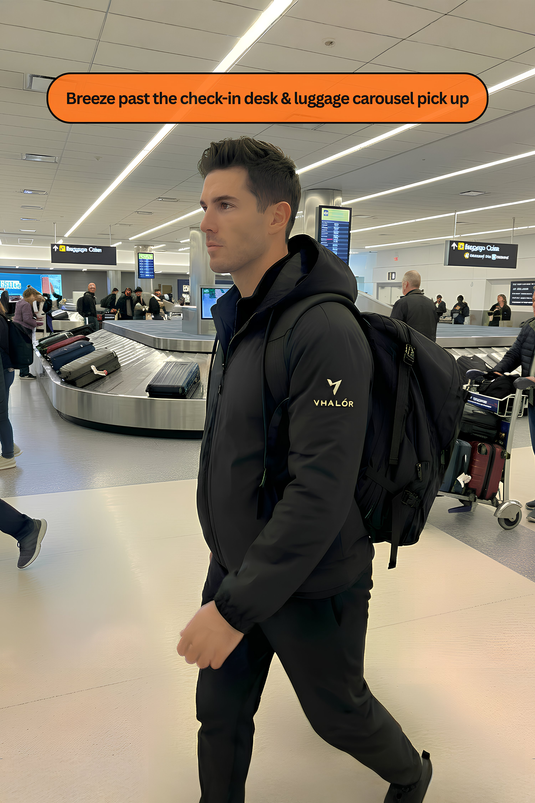
Last updated: August 2026
The short answer
No major U.S. airline gives the general public a free checked bag anymore. Southwest, the last holdout, ended "bags fly free" in April 2026. Expect to pay roughly $35 to $45 for a first checked bag on legacy carriers and $55 or more for a second. On budget carriers like Frontier, Breeze, Allegiant, Sun Country, and Avelo, even the overhead carry-on costs extra.
The four methods that actually get your fee to zero:
- Travel with only a personal item. Free on every airline, every fare, no exceptions.
- Carry a co-branded airline credit card. Waives the first checked bag, often for companions too.
- Wear your bulk. Clothing on your body is not a bag and is never counted or measured.
- Earn elite status. Free bags come standard at most tiers.
Everything below is the detail: what each airline charges right now, the fare-class trap that catches thousands of travelers at the gate, and how to squeeze a multi-day trip into the one bag that is always free.
Why did baggage fees go up in 2026?
Jet fuel roughly doubled after geopolitical disruptions, and fuel already accounts for about 20 to 25 percent of an airline's operating costs. When it spikes, airlines respond the way they always have: by moving the cost into ancillary fees rather than headline fares, because headline fares are what people compare when booking.
Most major U.S. carriers raised checked-bag fees by around $10 in early 2026, and several raised them again. Two structural changes landed in the same window. Spirit Airlines ceased all operations on May 2, 2026, the first major U.S. airline shutdown in 25 years, removing a price anchor from the budget segment. And Southwest, which had built its entire brand on free checked bags for 54 years, started charging in April 2026. There is no longer a major U.S. carrier where bags fly free by default.
How much does a checked bag cost in 2026?
Here is roughly what you will pay for checked bags on domestic routes. Prices are per bag, each way, and assume you prepay online.
| Airline | 1st checked bag | 2nd checked bag | Notes |
|---|---|---|---|
| American | $35 to $40 | $45 | Lowest of the legacy carriers; $5 more at the airport |
| Delta | $45 | $55 | $50 if you pay at the counter |
| United | $45 | $55 | Overweight bags can reach $200 to $400 |
| Southwest | $45 | $55 | Free-bag era ended April 2026 |
| JetBlue | $45 | $60 | Cheaper off-peak when prepaid |
| Frontier | $53 to $63 | varies | 40 lb weight limit, not 50; gate prices spike hard |
Fees change frequently and vary by route, fare, and timing. Always confirm with your airline before booking.
A few rules hold across the whole industry. Prepaying online at least 24 hours out saves $5 to $10 per bag versus the airport counter. A third checked bag can run around $200. Bags over 50 lbs trigger overweight surcharges starting near $100, and no airline accepts anything over 100 lbs.
What that actually costs on a real trip
The per-bag number understates it, because fees are charged each direction and per traveler. Here is the round-trip math at a typical $45 first-bag fee:
| Who is traveling | Round-trip bag cost | Over 3 trips a year |
|---|---|---|
| Solo traveler, 1 bag | $90 | $270 |
| Couple, 1 bag each | $180 | $540 |
| Family of four, 1 bag each | $360 | $1,080 |
That is the real number worth optimizing against. For a family that flies a few times a year, baggage fees have quietly become a four-figure annual line item.
Which airlines charge for a carry-on bag?
On legacy carriers, a full-size overhead carry-on is still free on standard fares. On the ultra-low-cost carriers it is a paid add-on, and the only genuinely free bag is the personal item under the seat. This is where a cheap headline fare quietly stops being cheap.
| Airline | Carry-on (overhead bag) | Free personal item? | Watch out for |
|---|---|---|---|
| Frontier | $60 to $99+, varies by route and timing | Yes | Most expensive in the segment |
| Breeze Airways | From $40 at booking on the basic "Nice" fare; flat $75 at the airport | Yes, 17 x 13 x 8 in | "Nice" fare is personal-item-only; carry-on is included on Nicer and Nicest |
| Allegiant | Paid on every fare; up to $75 per bag at the airport | Yes, 18 x 14 x 8 in | Both carry-on and checked cost extra |
| Sun Country | $25 to $40 at booking, $50 after, $55 at the gate | Yes, 17 x 13 x 9 in | A $10 gate handling fee stacks on top |
| Avelo | Paid, route-dependent | Yes | Use the airline's bag-price tool for your exact route |
Allegiant is also in the process of acquiring Sun Country, though the two still operate as separate airlines with separate baggage policies for now. Budget-carrier pricing moves with route and timing more than any other category, so always price your specific flight before booking.
What is the Basic Economy carry-on trap?
This is the single most expensive misunderstanding in air travel right now. On Basic Economy fares at American, Delta, United, and JetBlue, you are only guaranteed a personal item. No overhead bin access at all on domestic routes. Book that fare without realizing it and your roller bag gets checked at the gate for a fee, or you pay to upgrade your ticket on the spot.
Enforcement is tightening too. United deployed automated bag-size scanners at more than 35 airports in late 2025, with Delta and American testing similar systems. These flag oversized bags at the gate with no agent discretion involved. Regional jets gate-check anything that will not fit their smaller bins regardless. The era of talking your way past a busy gate agent is closing.
The practical conclusion: the personal item is the only allowance you can count on across every airline and every fare. Master it and the fees stop mattering.
What size personal item fits every airline?
Limits vary more than most travelers realize:
- Delta and American: around 18 x 14 x 8 inches
- JetBlue: 17 x 13 x 8 inches
- United: 17 x 10 x 9 inches, notably smaller
- Sun Country: 17 x 13 x 9 inches
- Alaska: the strictest of the majors
Buy one bag around 17 x 12 x 6 inches and it slides under any seat on any major U.S. carrier. That single decision removes the guesswork from every future booking.
9 proven ways to avoid baggage fees
1. Get a co-branded airline credit card
The most reliable fee-killer there is. United Explorer, Delta SkyMiles Gold, Southwest Rapid Rewards, Alaska Visa, and American AAdvantage cards all waive the first checked bag, and most extend it to companions on the same reservation. Annual fees run roughly $95, so the card pays for itself in about one round trip. Coverage for companions varies a lot: some cards cover up to eight people on the booking, others cover only the cardholder, so check that detail against how you actually travel.
2. Always prepay online
Adding bags during booking or online check-in saves $5 to $10 per bag versus the airport, and far more on budget carriers where gate pricing can double. Sun Country stacks a $10 gate handling fee on top. This is free money for thirty seconds of effort.
3. Earn or match elite status
Elite tiers include free checked bags at nearly every airline. If you concentrate your flying on one carrier, status is worth pursuing, and several airlines will match status you have already earned elsewhere.
4. Travel with only a personal item
If it fits under the seat, you owe nothing, on any airline, on any fare. A backpack counts as a personal item everywhere as long as it meets the size limit. This is the baseline every other strategy builds on.
5. Wear your bulkiest items
Coats, boots, and heavy sweaters do not count against any allowance when they are on your body. There is no rule limiting what you wear, and no scanner measures a person. Experienced travelers have used this for decades. The limitation has always been how much you can physically wear before it becomes absurd.
6. Wear your luggage with a compression travel jacket
This removes that limitation. A compression travel jacket has hidden vacuum-sealing compartments built into the lining, so a full bag's worth of clothing rides on your body, distributed evenly enough to wear comfortably. Because worn clothing is not a bag, it is not counted, not weighed, and not measured. It is the only zero-cost-per-trip method that also defeats Basic Economy restrictions. Details on how this works below.
7. Ship your bag ahead
For long trips or bulky gear, luggage-shipping services can beat overweight and oversize fees, and the bag is waiting when you arrive. Get a quote and compare it against the airline's fees before committing, since this rarely wins for ordinary luggage.
8. Split weight across travelers
Flying with others? Distribute items so no single bag crosses 50 lbs and triggers an overweight surcharge. If one traveler holds an airline card, put the checked bag on their reservation.
9. Price the whole trip, not the fare
On Frontier, Breeze, Allegiant, Sun Country, and Avelo, the carry-on is a paid add-on, so a "cheap" fare can cost more all-in than a legacy carrier once bags are added. On long-haul international economy the reverse is often true, since a checked bag is frequently included. Always compare the all-in price.
How does a compression travel jacket beat baggage fees?
Of every strategy above, wearing your luggage is the only one that costs nothing per trip, requires no credit application, and works identically on every airline and every fare class. Airlines regulate bags. They do not regulate clothing.
The Travhalór travel jacket is built around that gap. Discreet interior compartments hold fabric vacuum bags that compress with an included wireless pump, so the load flattens and distributes across the jacket instead of bulging in one spot. Why it works as a fee-avoidance tool:
- Worn clothing is not counted. Not as a checked bag, not as a carry-on, not as your personal item.
- It defeats the Basic Economy trap. Even on a personal-item-only fare, what you wear is yours to bring.
- Automated sizers do not apply. Bag scanners measure bags.
- It converts when you land. Open it up and it wears as a shoulder bag, and it gives you overflow space when a personal item will not close on the way home.
Treat it as a wearable extension of your free allowance. Against a $90 round-trip checked-bag cost for a solo traveler, the math is straightforward.
Frequently asked questions
Do any U.S. airlines still offer free checked bags?
Not for the general public. Southwest was the last major carrier with free checked bags and ended that policy in April 2026. You can still get a free bag through a co-branded airline credit card, elite status, premium cabins, or active-duty military benefits.
What is the cheapest way to avoid checked bag fees?
Traveling with only a personal item costs nothing and works on every airline. When you need more capacity than fits under a seat, wearing clothing in a compression travel jacket is the only method with no per-trip cost that also works on Basic Economy fares.
Which airlines charge for a carry-on bag?
Frontier, Breeze on its basic "Nice" fare, Allegiant, Sun Country, and Avelo all charge for the overhead carry-on, leaving only the under-seat personal item free. Legacy carriers include a carry-on on standard fares but restrict Basic Economy to a personal item only. Spirit exited the market in May 2026.
Can I bring a carry-on on a Basic Economy ticket?
Usually not. American, Delta, United, and JetBlue restrict Basic Economy to a personal item only on domestic routes. Confirm your fare's baggage rules at booking rather than assuming, since this is the most common source of surprise gate fees.
Is wearing a jacket full of clothes actually allowed on a plane?
Yes. Airlines set limits on bags, not on clothing worn on your body. There is no rule against wearing a jacket regardless of what it holds, and worn items are not weighed or measured.
How do I avoid gate-check fees?
Make sure your bag meets the published carry-on or personal-item dimensions, board earlier when bins are the constraint, and remember that regional jets have smaller bins than mainline aircraft. Moving bulk onto your body keeps that volume off the sizer entirely.
Do baggage fees apply each way?
Yes. Fees are charged per bag, per passenger, per direction. A single checked bag on a round trip at $45 each way costs $90, which is why the totals add up faster than most travelers expect.
Is it cheaper to check a bag or pay for a carry-on?
On legacy carriers the carry-on is free on standard fares, so it is always cheaper. On budget carriers the two are priced similarly and sometimes the carry-on costs more, since airlines price for the convenience of keeping your bag with you. Price both for your specific route.
The bottom line
Baggage fees in 2026 are a tax on travelers who have not planned. Get the airline card if you fly often, always prepay, buy one personal item that fits every carrier, and for the trips where you need to bring more without paying more, wear it. The fee only exists if you hand them a bag.