Last updated: August 2026
What is wearable luggage?
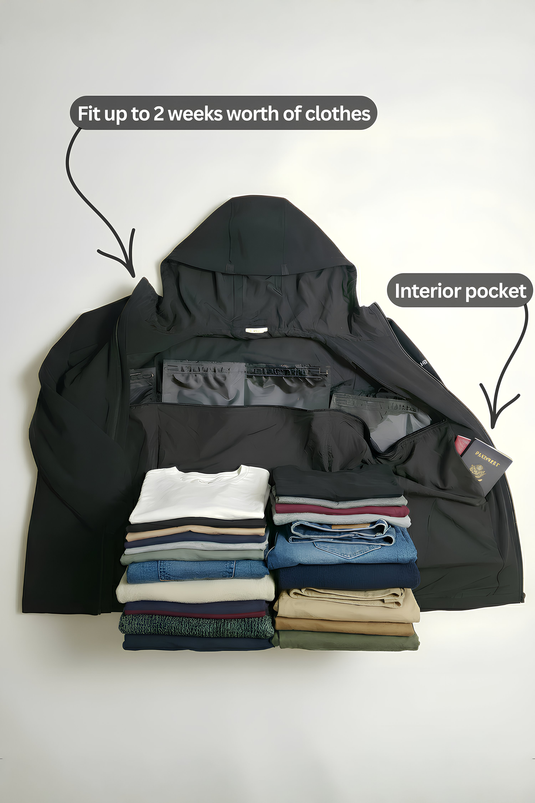
Wearable luggage is clothing designed to carry your belongings on your body instead of in a bag. It usually takes the form of a jacket, coat, or vest with hidden internal compartments sized for clothing rather than just phones and passports.
The reason it exists is simple: airlines set limits on bags, not on what you wear. Worn clothing is not counted toward your checked, carry-on, or personal item allowance, and it is not weighed or measured at the gate. Moving volume from your bag onto your body therefore moves it outside the fee structure entirely.
There are three broad designs, covered in detail below: pocket-based jackets and vests, convertible jacket-to-bag garments, and compression-based jackets that vacuum-seal clothing to reduce its volume before storing it.
How does wearable luggage actually work?
Every design solves the same problem in a different way: clothing is bulky mostly because of trapped air, and a garment has limited space before it stops looking or feeling like a garment.
Pocket-based designs distribute items across many internal compartments. SCOTTeVEST, which largely defined the modern category, builds jackets and vests with twenty or more pockets. This works extremely well for dense, awkward items: electronics, chargers, documents, water bottles. It works less well for clothes, because folded fabric full of air fills a pocket quickly and creates visible bulges.
Convertible designs turn the garment itself into a bag once you are past the gate. Jaktogo and similar products fold into a duffle shape. The trade-off is that you are carrying the same volume either way, just relabeled.
Compression-based designs attack the air directly. Clothing is placed in vacuum bags, the air is drawn out, and the flattened result is loaded into the lining. Because the volume is reduced before storage rather than after, the same clothing occupies noticeably less space and the garment keeps a flatter profile. This is the approach the Travhalór uses, with three nylon vacuum bags and a portable electric pump included.
A common misconception about compression designs is that they are all-or-nothing. They are not. The bags come out when you are trying to maximize capacity; on a lighter trip you can load the compartments directly and leave them behind. And where a pump is included it speeds the job up rather than being a requirement, since a sealed bag can be rolled by hand to push the air out.
Types of wearable luggage compared
| Approach | Best for | Weakness | Examples |
|---|---|---|---|
| Pocket jacket or vest | Electronics, documents, dense small items | Bulges when loaded with clothing | SCOTTeVEST, BauBax |
| Convertible jacket to bag | Getting past the gate, then repacking | Same volume, just relocated | Jaktogo, Bagket |
| Compression jacket | Maximum clothing volume in minimum space | Extra step to pack; not for rigid items | Travhalór |
| Weighted travel vest | Heavier items, simple loading | Visibly bulky; limited capacity | Stuffa |
Capacity claims vary widely between manufacturers and are rarely measured the same way. Treat any stated figure as a manufacturer claim unless it specifies what was packed.
Does wearable luggage actually work?
Yes, with limits worth understanding before you buy.
What it does well. Soft, compressible items are ideal: t-shirts, underwear, socks, thin layers, lightweight trousers. These are also the items that dominate a short-trip packing list by volume, which is why shifting them to a garment frees up so much bag space.
What it does not do. Rigid and dense items are a poor fit. Shoes, toiletry bottles, books, and hard electronics do not compress, and weight is still weight: a heavily loaded garment is heavier to wear than a bag is to roll. Anyone claiming a jacket replaces a full checked bag for a two-week trip is overselling it.
The realistic use case is turning a carry-on trip into a personal-item trip, or a personal-item trip into a no-fee trip. That is a meaningful saving on fares where a carry-on is not included, but it is not unlimited free capacity. Our guide to packing a week into a personal item walks through the method.
Is wearable luggage allowed on planes?
Yes. Airlines regulate baggage, not clothing. There is no rule limiting what you wear, and worn items are not weighed or measured against an allowance.
Two practical points. At security screening you remove outerwear and send it through the X-ray like any other jacket, so pack it so it is easy to take off and put back on. And while gate agents check bag sizes, they have no basis to measure a garment you are wearing.
This matters most on Basic Economy fares at American, Delta, United, and JetBlue, which restrict you to a personal item only with no overhead bin access, and on budget carriers such as Frontier, Breeze, Allegiant, Sun Country, and Avelo, where the overhead carry-on is a paid add-on. In both cases the free allowance is a single under-seat personal item, and what you wear sits outside that limit. Our guide to avoiding baggage fees covers the fare rules in detail.
Who should and should not buy wearable luggage
It makes sense if you fly several times a year on fares that do not include a carry-on, you travel carry-on only and keep running out of space, you are a one-bag or minimalist traveler, or you frequently need overflow room on the return leg when purchases will not fit.
It makes less sense if you mostly fly long-haul international economy where a checked bag is usually included, you already hold an airline credit card or elite status that waives bag fees, or your packing is dominated by shoes, equipment, and other rigid items.
A useful way to judge the value is per-trip cost. A single checked bag at roughly $45 each way costs $90 round trip, so the arithmetic depends on how often you fly the kind of fare where that applies.
How to choose a wearable luggage jacket
- Decide what you are carrying. Clothing favors compression designs; gadgets and documents favor pocket designs.
- Check how weight is distributed. Capacity concentrated in a few large compartments pulls unevenly and is uncomfortable over a long day.
- Look at how it wears empty. A garment you would not otherwise wear becomes a costume, and you will leave it at home.
- Confirm what is included. Compression designs use vacuum bags, and often a pump; check whether they ship with the garment or cost extra.
- Read the returns policy. Fit matters more than usual when the garment is designed to be loaded.
Frequently asked questions
What is wearable luggage?
Wearable luggage is clothing, typically a jacket, coat, or vest, built with hidden internal compartments sized to carry clothing and belongings on your body rather than in a bag. Because airlines limit bags rather than clothing, worn items are not counted toward any baggage allowance.
Is wearable luggage allowed on a plane?
Yes. Airlines set limits on bags, not on what you wear, and worn clothing is not weighed or measured. You remove outerwear at security screening like any other jacket.
Does wearable luggage count as a carry-on or personal item?
No. Worn clothing is not counted as either, which is why it is useful on Basic Economy fares that allow only a personal item, and on budget airlines that charge for the overhead carry-on.
How much can a wearable luggage jacket hold?
It depends on the design and on what you pack. Soft, compressible clothing such as t-shirts, underwear, and thin layers is where these garments perform best. Rigid items such as shoes and bottles do not compress and are a poor use of the space. Manufacturer capacity claims vary and are rarely measured consistently, so treat them with caution.
Do compression jackets require a pump?
Not necessarily. A pump is faster and gets the bags flatter, but a sealed vacuum bag can be rolled by hand from the closed end to push the air out. You can also skip the bags altogether on a lighter trip and load the compartments directly.
What is the difference between a wearable luggage jacket and a travel vest?
Travel vests are usually pocket-based, optimized for electronics, documents, and small dense items. Wearable luggage jackets are designed around carrying clothing volume, either through larger compartments or through compression.
Is wearable luggage worth it?
It is worth it if you regularly fly fares that do not include a carry-on, or travel carry-on only and keep running out of room. It is not worth it if your bag fees are already waived by a credit card or status, or if you mostly pack rigid items.
The bottom line
Wearable luggage is a narrow tool that works very well within its limits. It will not replace a suitcase for a long trip with bulky gear. It will reliably move several days of clothing outside the fee structure, and on the fares where a carry-on costs extra, that is the difference between paying and not paying.
If clothing volume is your constraint, compression is the approach that addresses it most directly.