Last updated: August 2026
The short version
Packing a week into a personal item is a volume problem, not a discipline problem. A personal item holds roughly 20 to 26 litres. A week of clothing packed normally takes up more than that. So the method is not "bring less," it is "make the same clothes take up less room."
Three things do almost all the work:
- A tight capsule wardrobe. One color palette, everything pairs with everything, no single-use items.
- Compression. Air is the enemy. Squeeze it out and the same clothes shrink dramatically.
- Wearing your bulk. Your heaviest items should be on your body, not in the bag.
How big is a personal item, really?
Limits vary more than most travelers realize, and the smallest one determines what you can safely buy.
| Airline | Personal item limit |
|---|---|
| Delta | Around 18 x 14 x 8 in |
| American | Around 18 x 14 x 8 in |
| Sun Country | 17 x 13 x 9 in |
| JetBlue | 17 x 13 x 8 in |
| Breeze | 17 x 13 x 8 in |
| United | 17 x 10 x 9 in |
| Alaska | The strictest of the majors |
Always confirm with your airline before flying. Limits change and vary by route and fare.
Buy for the smallest, not the average. A bag around 17 x 12 x 6 inches fits under any seat on any major U.S. carrier, which removes the guesswork permanently. In practice that is roughly 20 to 26 litres of usable space.
Step 1: Build a capsule, not a suitcase
The mistake most people make is packing outfits. Pack a system instead: a small set of pieces where every top works with every bottom. Seven outfits from nine items beats seven outfits from fourteen.
Three rules make this work:
- One palette. Pick neutrals for bottoms and outerwear, and allow color only in tops. Everything then matches by default.
- No single-use items. If a piece works for exactly one occasion, it stays home unless that occasion is the reason for the trip.
- Count in wears, not days. Bottoms get worn three to four times, tops one to two. A week does not need seven of anything except underwear and socks.
A worked example: 7 days, one personal item
| Category | Quantity | Notes |
|---|---|---|
| Tops | 4 | Mix of short and long sleeve, all matching the same bottoms |
| Bottoms | 2 | One worn, one packed |
| Underwear | 5 to 7 | Quick-dry fabric so you can wash in a sink |
| Socks | 4 | Merino resists odor and dries fast |
| Mid layer | 1 | Fleece or light knit |
| Outer layer | 1 | Worn, not packed |
| Sleepwear | 1 | Or double up a t-shirt |
| Shoes | 2 total | Heaviest pair worn, one light pair packed |
That is a genuine week. The reason it does not fit a personal item when packed conventionally is not the item count, it is the air between the fibers.
Step 2: Compress everything soft
Folded clothing is mostly air. This is why packing cubes disappoint people: a standard cube organizes your clothes without removing the air, so you get tidiness rather than space.
What compresses well: t-shirts, underwear, socks, thin knits, lightweight trousers, sleepwear, and down or synthetic insulation, which compresses better than almost anything.
What does not: shoes, toiletry bottles, electronics, books, and anything rigid. These set a hard floor on your packed volume, which is why cutting from two pairs of shoes to one saves more space than removing four shirts.
The compression method
- Sort into compressible and non-compressible piles. Only the first pile gets compressed.
- Roll rather than fold. Rolling removes air before you start and reduces creasing.
- Load a vacuum bag loosely. Overstuffing traps air in pockets and the bag will not flatten evenly.
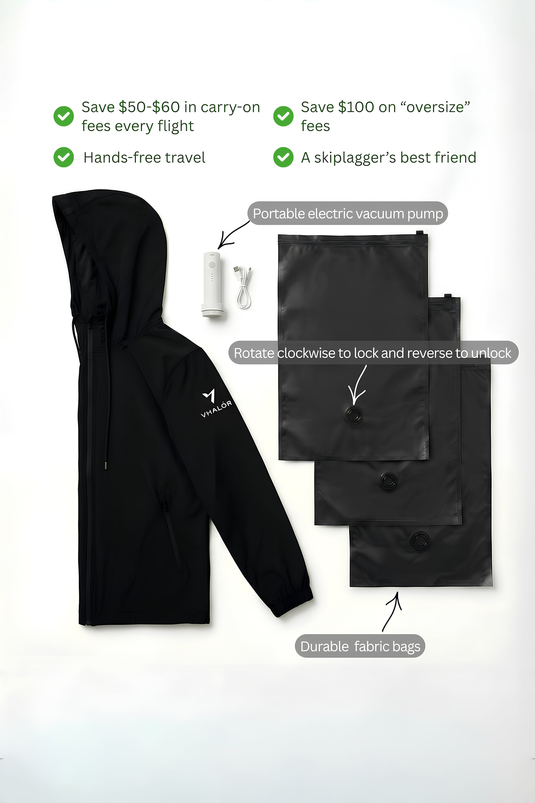
- Remove the air, either with a pump or by hand. A pump is faster and gets the bag flatter, but you do not need one: seal the bag and roll it firmly from the closed end toward the valve, pushing the air out ahead of you. For soft items this gets you most of the way there.
- Pack flat, stacking sealed bags like plates rather than stuffing them in like pillows.
One practical note: compressed clothes come out creased, so hang them the night you arrive or pack one wrinkle-resistant outfit separately for arrival day.
The return leg is not a problem. This is where people assume they are stuck if the pump is packed at the bottom of a bag or left behind. Because the bags can be rolled flat by hand, you can re-compress everything in a hotel room with nothing but your arms.
Step 3: Wear your heaviest items
Anything on your body is not in your bag. This is the oldest trick in one-bag travel and still the most effective, because your bulkiest items are usually your heaviest.
Wear the heavier shoes, the jeans or thicker trousers, and your outer layer to the airport. If that outer layer is a wearable luggage jacket, it becomes storage rather than just something you are carrying, which is where the remaining volume goes when the bag is genuinely full. Our guide to wearable luggage explains how the different designs compare.
Worth knowing: a compression jacket does not have to be run at maximum. The vacuum bags are what you reach for when you are trying to squeeze in every last item, but the jacket's compartments hold clothing perfectly well on their own. On a short trip where space is not tight, skip the bags entirely and just load the lining.
The honest version: this works well for clothing and poorly for everything else. It will not solve a camera kit, hiking boots, or a laptop plus two chargers. Those belong in the bag, and they are the reason to be ruthless everywhere else.
Step 4: Plan to do laundry once
This is the step that turns a week into two. One sink wash midweek means you pack four days of clothing rather than seven, and quick-dry fabrics make it a twenty-minute job rather than an ordeal.
Bring a small amount of detergent, wash underwear and socks in the sink, roll them in a towel to squeeze out water, then hang overnight. Merino and synthetics dry by morning. Cotton often does not, which is the main argument for avoiding it on longer trips.
What to leave behind
- "Just in case" clothing. If you cannot name the day you will wear it, it is not coming.
- Full-size toiletries. Solid formats save the most space and avoid liquid limits entirely.
- A third pair of shoes. Almost never justified for a week.
- Anything you can buy there. Toothpaste and sunscreen exist at your destination.
- Cotton, for longer trips. It is heavy, bulky, and slow to dry.
Frequently asked questions
Can you really pack a week in a personal item?
Yes, for most trips. It requires a capsule wardrobe where everything matches, compression for the soft items, wearing your bulkiest pieces, and one midweek laundry session. It becomes difficult when the trip requires specialized gear, formalwear, or multiple pairs of shoes.
What size bag counts as a personal item?
Limits vary by airline, from roughly 18 x 14 x 8 inches down to United's 17 x 10 x 9 inches. A bag around 17 x 12 x 6 inches fits under the seat on any major U.S. carrier.
Do packing cubes actually save space?
Standard cubes organize rather than compress, so they save little volume. Compression cubes and vacuum bags remove air and genuinely reduce the space clothing occupies.
Do you need a pump to use vacuum compression bags?
No. A pump is faster and gets the bag flatter, but you can seal the bag and roll it firmly from the closed end toward the valve to push the air out by hand. That makes compression practical on the return leg even if the pump is buried or left at home.
How do you deal with shoes when packing light?
Wear the heaviest pair and pack at most one lighter pair. Shoes do not compress, so they set the floor on how small your packed volume can get. Stuff socks inside packed shoes to use the dead space.
How many outfits do you need for a week?
Roughly four tops and two bottoms covers seven days if everything matches and you do one laundry session. Bottoms can be worn three to four times, tops one to two.
Does compressed clothing wrinkle?
Yes, some. Roll rather than fold to reduce creasing, hang clothes the night you arrive, and keep one wrinkle-resistant outfit packed separately for arrival day.
The bottom line
Packing a week into a personal item is not about willpower. It is about attacking volume in three places: fewer, better-matched pieces; compression on everything soft; and moving your heaviest items onto your body. Do those three and the bag closes with room to spare.